Commercial · Georgetown
Master Key System Design in Georgetown
On the warehouse floor, a shift supervisor's key opens the loading dock, the tool crib and the manager's office, though only the dock is really part of the job. Nobody planned it that way; the key was simply copied from whichever one was closest at hand.
Master Key System Design
In plain words
What a business actually takes away from a master key system project is a documented chart, not just a set of new keys. Every level is recorded against the doors it opens, every key is marked by role rather than by address, and the cylinders have been tested individually and as a group before handover. That record becomes the reference for everything that follows: adding a new employee, handling a departure, or working out exactly what is affected if one key later goes missing, instead of guessing from a label on a keyring.
How the visit goesA dental office wants the front desk to lock up at night without ever holding a key to the room where patient records and controlled supplies are stored. Right now one master key opens both, which nobody is comfortable with once it is pointed out.
Georgetown
How the visit goes
Room to grow before it is needed
The assessment asks about plans the business already has in mind: a leased unit expected to fill, a department likely to split in two, a location due to open next year. Building spare capacity into the keying platform now is far simpler than adding a level to a system that is already fully pinned, which can mean touching cylinders that were never meant to change. This forward-looking check shapes which keying platform and how many reserved combinations the design settles on before any cylinder is committed to a specific level.
Choosing a platform with room in it
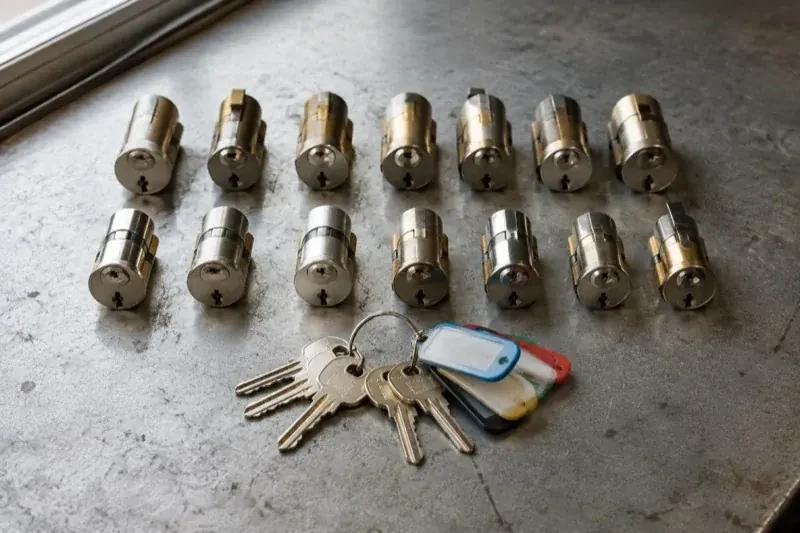
The keying platform and keyway are chosen to hold every level the design calls for, plus a margin for doors that are likely to join later. Each cylinder is then pinned chamber by chamber to the planned bittings, with bottom and master pins stacked together to create the shear lines every level needs to turn that one cylinder. Getting this stacking right is what prevents a common mistake: a change key that, through an overlooked shared pin, quietly opens more than the door or keyed-alike group it was meant for.
A plan for the next new hire or department
Adding someone to the system afterward is usually a matter of consulting the existing chart and issuing them a copy of the authorized key their role already calls for, rather than opening the whole hierarchy back up. A genuinely new combination is only usable on doors whose cylinders are pinned to accept it, so the same chart shows whether that means picking an existing bitting or scheduling a repin, keeping the decision informed rather than improvised.
Master Key System Design
In the van
- Key marking tools
- Cylinder pinning kit
- Locking chart storage cabinet
- Change and master keys
- Plug follower and key gauge
What affects the quote
Same fees day, night or weekend
1Number of keys cut and marked
Each key cut and marked for a holder is counted individually in the quote, whether it is a change key for one door or a top-level master for an owner. More staff at the same level naturally means more keys cut than a business with only a handful of holders.
2Collecting and retiring old keys
Gathering up old keys that are being replaced, confirming they no longer operate any cylinder, and retiring them from circulation is a small additional step some businesses want included, separate from the core design and cutting work.
3Sub-master levels beyond the basics
One or two sub-master levels are typical for most properties. A more elaborate hierarchy, with several sub-masters covering overlapping departments or floors, takes longer to design correctly and test, and that additional design and testing time is reflected in the quote.
Master Key System Design: questions
How do you decide how many sub-master levels a business actually needs?
The number follows the organization, not a preference for tidy diagrams. Genuinely distinct groups, such as separate departments or floors with different access needs, each justify a level; access differences that exist only on paper usually do not. A hierarchy with more levels than the business uses in practice is harder to administer without making anyone's day-to-day access meaningfully better.
What is a master key system, in plain terms?
It is a set of keys arranged in levels rather than issued one at a time. An individual change key opens one door, or a small group of doors keyed alike. A sub-master opens a defined group of doors, such as everything on one floor. A single top-level master opens the whole set. The levels are designed around who actually needs each one, then cylinders are pinned to match, so the physical keys follow an organization's real structure instead of years of informal copying.
What happens if a department splits or a business reorganizes?
The existing chart is the starting point rather than a blank page. Doors that move to a new department are reassigned within the existing hierarchy where the cylinders and platform allow it, and only the affected levels are touched. A reorganization is usually an adjustment to the record, not a reason to rebuild the whole system from the ground up.
Commercial Locks

- Access Control InstallationYou just leased the empty unit next door and want the new tenant to open their own suite without a…
- Panic & Exit HardwareTwo doors used to swing as a pair at the community hall entrance, but one leaf has started closing…
- Commercial-Grade Lock ReplacementThe key to the office entrance turns with almost no resistance now, and some mornings the deadbolt…
Master Key System Design near you
The services offered in Georgetown answer the questions a door eventually asks. Who else has a key? Why does the bolt drag? Would a stronger cylinder be worth it? Can staff leave without a key? How do I open the safe my father left? Each answer is on the pages below.