Commercial · Halton Hills
Panic & Exit Hardware
Two doors used to swing as a pair at the community hall entrance, but one leaf has started closing before the other, catching the astragal and leaving a gap wide enough to worry the caretaker.
Panic & Exit Hardware
In plain words
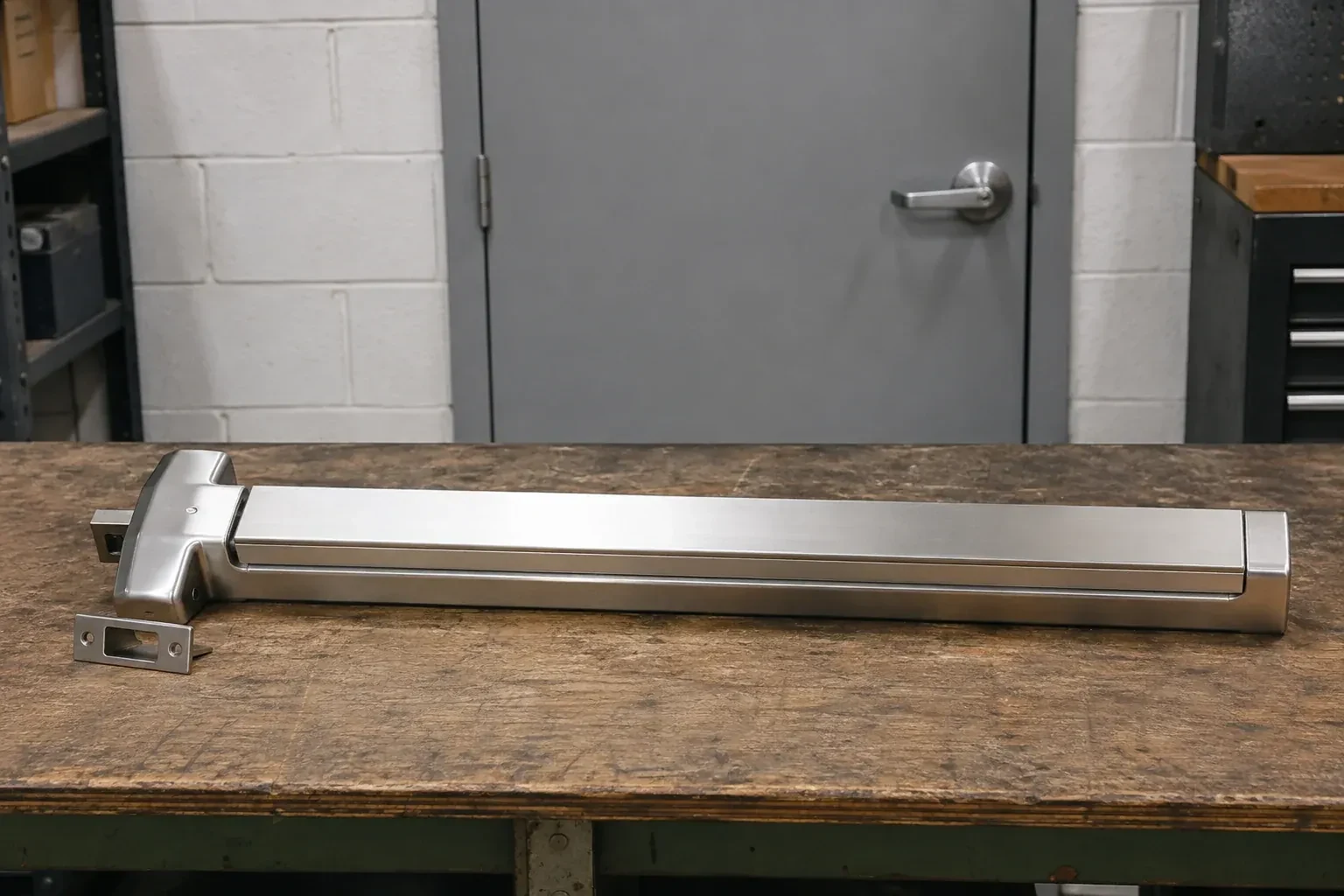
Electrified exit hardware adds a layer without changing the basic behaviour of the door: a person inside can still leave under one motion of the hand, every time. A request-to-exit switch tells an access-control panel that the pushpad or crossbar was actuated, usually paired with a door-position contact so the panel can also tell a normal exit from a forced or propped door. Electric latch retraction lets a fire-rated opening behave like a push-pull door for staff, provided it relatches automatically on a fire-alarm signal, since that kind of door never carries a mechanical dogging function. An alarm module sounds when the device is used.
How the visit goesThe fire inspector's note is blunt: the banquet hall's second exit still turns on a deadbolt, and the crowd it is rated to hold needs a door that opens under one motion, no key involved.
Halton Hills
How the visit goes
Accessibility and reach at the door
The assessment also looks at who has to operate the door: mounting height, the force needed to release the touchpad or crossbar, and whether the outside trim's lever or pull suits someone with limited grip or reach. A door that meets a code minimum can still be awkward for the people who use it every day, so this check asks not only what is required but what will work well for the staff and visitors who pass through the opening.
Testing release force and full latch engagement
Once mounted, every device is cycled by hand repeatedly, checking that the touchpad or crossbar releases the latch under a light, even push and that the door swings clear of its frame and any threshold without binding. The strike is checked from both sides to confirm the latch seats fully when the door is pushed closed, not only when it is guided into place by hand. Any adjustment the testing reveals is made on the spot, before the device is called finished.
A pair of doors that behaves like one exit
Where a pair was involved, both leaves now latch the way that pair's hardware was designed to: some close in a fixed order guided by a coordinator, with an astragal or a compatible vertical-rod arrangement keeping the opening reading as a single wide exit, while others latch independently on their own without needing either. Anyone walking through it day to day should notice nothing except a door that swings, closes and latches without a hand having to guide the second leaf into place.
Panic & Exit Hardware
In the van
- Outside trim (pull, lever or cylinder)
- Strike and reinforcement
- Signage and labels
- Coordinator for door pairs
- Astragal and mullion hardware
What affects the quote
Same fees day, night or weekend
1Removing hardware that should not remain
A padlock, hasp or extra deadbolt found on the door is removed and the resulting holes are filled or covered as part of the same visit, which is its own small task in the quote.
2Door and frame condition
A door that has sagged, a frame that has shifted, or a strike pocket that no longer lines up needs correcting before hardware is fitted, which adds its own line to the quote.
3Condition of the existing hardware
A device that only needs adjustment, cleaning and new fasteners costs less in labour than removing a seized or badly worn device and fitting a replacement in its place.
Panic & Exit Hardware: questions
Can exit hardware be styled to match the rest of the building's finishes?
Yes, within what the door's rating allows. Exit devices and their trim come in a range of finishes to sit alongside other door hardware in the building, and outside trim in particular, being the visible part from a public side, can be chosen to match levers or pulls used elsewhere. A fire-rated opening narrows the finish choice somewhat, since the whole assembly has to stay within its listing.
What is dogging, and can every door have it?
Dogging holds the device's latch retracted so the door works as a simple push-pull for a period, useful during business hours on a busy entrance. It is not available on fire-rated openings, because a fire door must keep an active latch at all times; on those doors, electric latch retraction achieves a similar push-pull convenience without ever leaving the latch mechanically held back.
How is panic hardware different from fire exit hardware?
Panic hardware and fire exit hardware share the same push-to-release action, but fire exit hardware is additionally tested and listed for use on a fire-rated door assembly. That extra listing matters because a fire door has to keep an active latch bolt at all times; it cannot carry a mechanical dogging function the way ordinary panic hardware sometimes can, so the two are not interchangeable on a rated opening.
Commercial Locks
- Master Key System DesignOn the warehouse floor, a shift supervisor's key opens the loading dock, the tool crib and the…
- Access Control InstallationYou just leased the empty unit next door and want the new tenant to open their own suite without a…
- Commercial-Grade Lock ReplacementThe key to the office entrance turns with almost no resistance now, and some mornings the deadbolt…
Panic & Exit Hardware near you
The pages that follow describe the lock services offered in Halton Hills one by one, without sales talk. Where a service has a simpler or less involved cousin, the page says so. Where a repair will do instead of a replacement, the page says that too. The aim is for you to choose well, not to choose more.