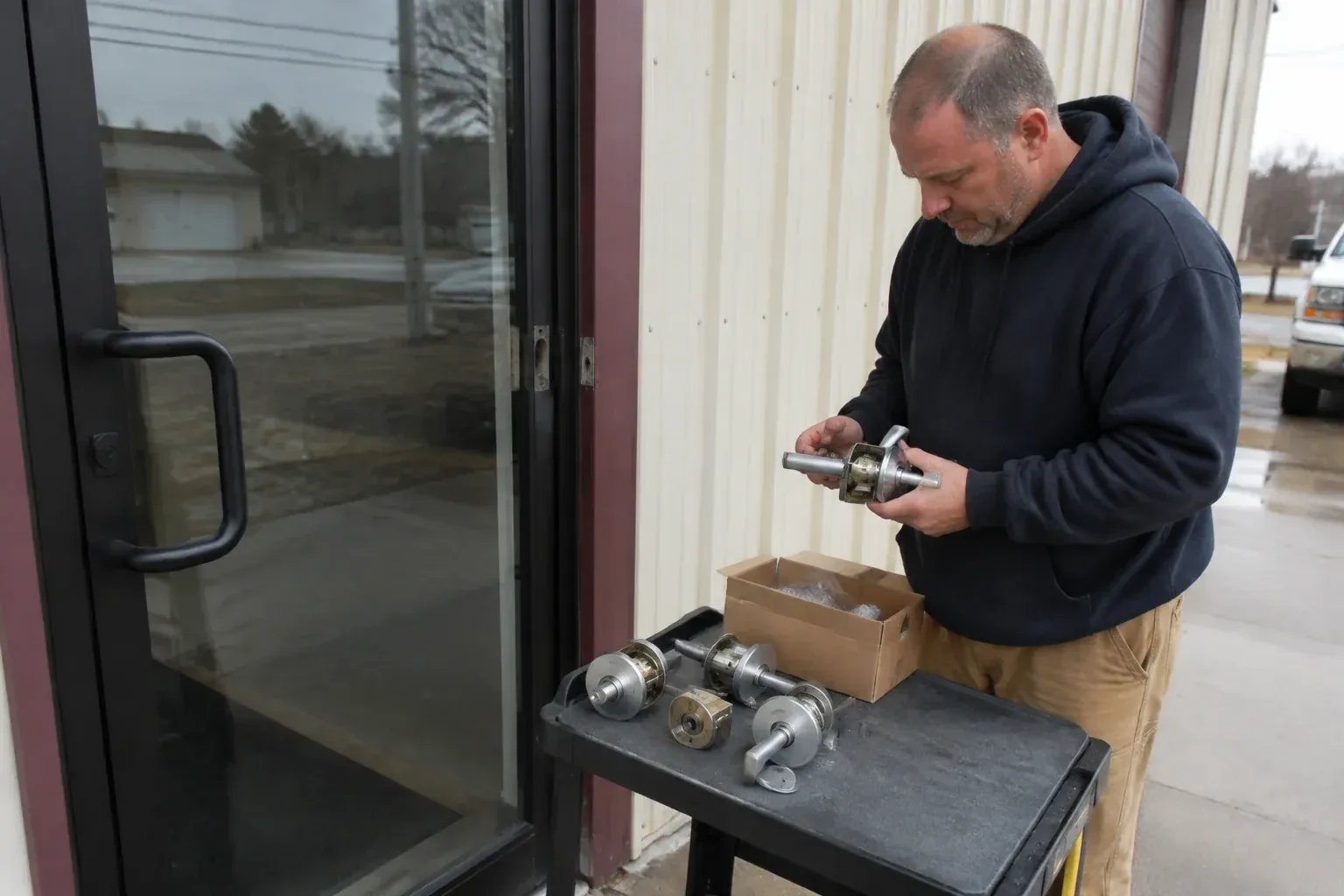
Commercial · Halton Hills
Commercial-Grade Lock Replacement
The key to the office entrance turns with almost no resistance now, and some mornings the deadbolt does not fully retract until someone jiggles the handle and tries the key again.
Commercial-Grade Lock Replacement
In plain words
Where a home lockout is mostly about getting one door open again, a commercial lock replacement is mostly a decision about a system: how this one door's hardware fits into every other lock the business already manages. The locksmith examines the existing keying, whether cylinders are standard, interchangeable-core or restricted, and whether other doors should be keyed the same way as this one. New hardware is chosen to match the door's fire rating and occupant load where those apply, installed without altering the door's existing prep, and finished with keys cut, tested and recorded in the business's own key-control log.
How the visit goesA new tenant moved into the unit next door, and the property manager just found three different cylinders on three doors, none of them cut to the same key.
Halton Hills
How the visit goes
Finding what else is already wired to the door
Many commercial openings carry more than a mechanical lock: an electric strike, a maglock, a door position switch feeding an alarm panel, or a card reader tied to an access-control system. The locksmith identifies everything already connected to the opening before ordering replacement hardware, since a new lock has to coexist with that wiring rather than replace it by accident. Where the connected hardware is the actual source of the problem, that gets flagged separately rather than folded silently into a mechanical lock replacement.
Preserving the door's required behaviour
On a door required to close and latch on its own, the new hardware is installed and the closer adjusted so that behaviour still happens after the work is done: the door swings shut, the latch engages, and nothing about the new lock lets it be secured open in daily use. On an exit route where listed push-type hardware is required, the entire route from that door to the outside is checked so the new hardware fits the same standard as the rest of the path rather than becoming the one mismatched link in it.
Electrified hardware working as one system
If the door carries an electric strike, a maglock or a card-reader tie-in, that hardware has been tested together with the new mechanical lock rather than left to be sorted out separately. The release button, the reader and the mechanical latch now agree with each other, so staff are not shouldering a door that is supposedly already unlocked. Anyone monitoring the door through an alarm panel or access-control software can confirm the contact reports correctly against the new hardware.
Commercial-Grade Lock Replacement
In the van
- Heavy-duty cylindrical lockset
- Mortise lock body
- Hookbolt and deadlatch hardware
- Strike plates and keepers
- Restricted keyway cylinder
What affects the quote
Same fees day, night or weekend
1Panic or exit hardware
Listed exit devices cost more than a standard lockset and are quoted per opening, since a route requiring this hardware often needs it consistently across more than one door along that path.
2Interchangeable-core hardware
Interchangeable-core cylinders cost more up front than standard ones but reduce the cost of every future rekey, since the business can swap cores itself. Whether that trade-off suits you shapes which cylinder type is quoted.
3Number of keys cut and issued
Keys are counted individually into the quote. A small office needing a handful of keys is a smaller line item than a multi-shift operation issuing keys to a large staff roster.
Commercial-Grade Lock Replacement: questions
What is the difference between a mortise lock and a cylindrical lockset?
A mortise lock has its whole mechanism, latch, deadbolt and sometimes a separate handle function, built into one case that sits inside a pocket cut into the door's edge. A cylindrical lockset is a bored-in unit, simpler to service, common on standard commercial and residential doors alike. Which one your door takes depends on how it was originally prepped, not on preference alone.
Who should hold the master key once the system is set up?
That is a decision for the business, not the locksmith, but the general practice is to limit master keys to the smallest number of people who genuinely need building-wide access, and to log who holds each one. Sub-master and change keys can then cover departments, shifts or single doors without every key holder carrying access to everything.
My storefront door is aluminum and glass. Does it need special hardware?
Yes. An aluminum storefront door has a narrow stile, the vertical metal frame around the glass, that a standard mortise or cylindrical lock cannot physically fit into. These doors take a narrow-stile lock or a hookbolt built specifically for that slim profile, and matching the hardware to the frame is what lets the bolt engage the keeper fully instead of catching at an angle.
Commercial Locks
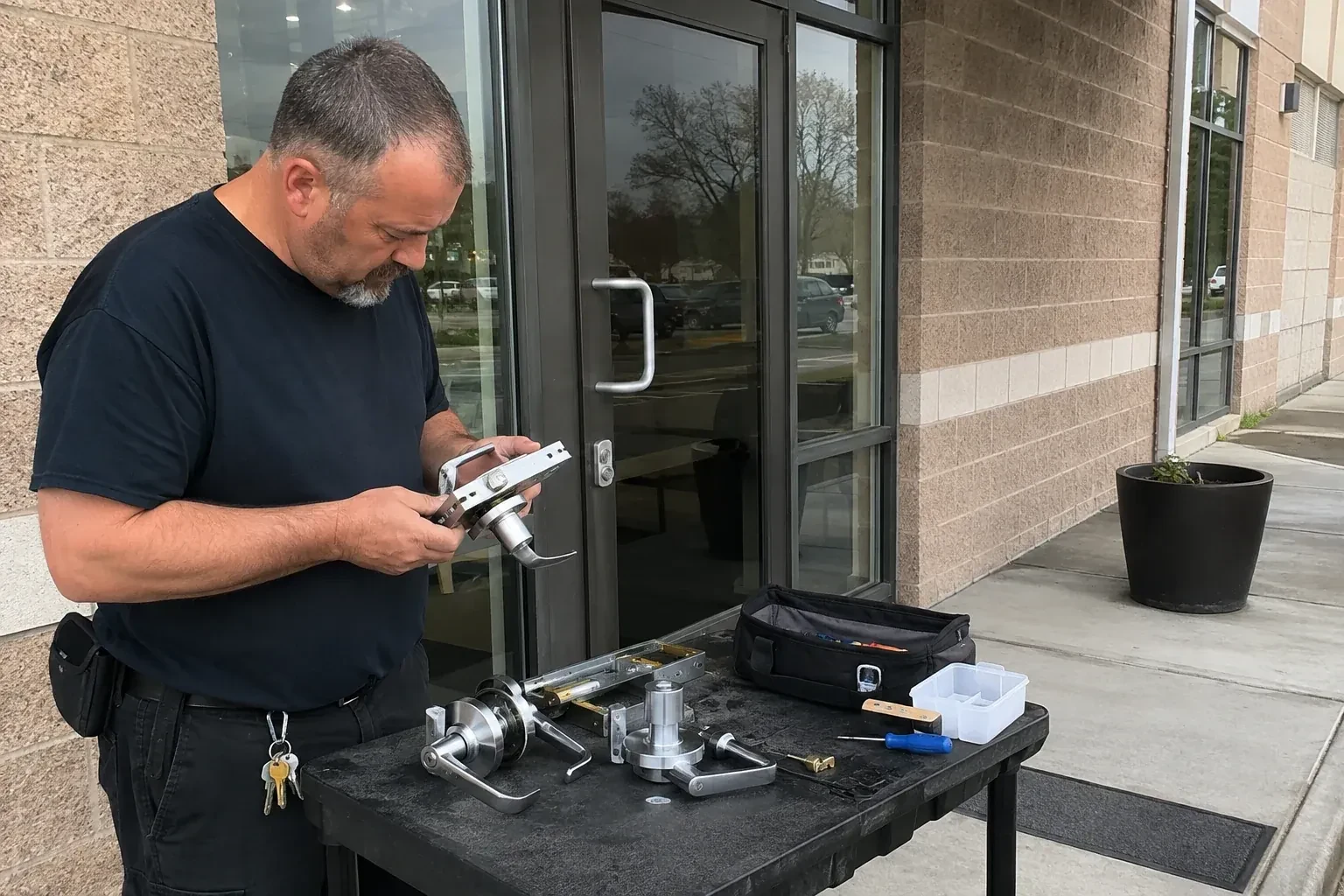
- Master Key System DesignOn the warehouse floor, a shift supervisor's key opens the loading dock, the tool crib and the…
- Access Control InstallationYou just leased the empty unit next door and want the new tenant to open their own suite without a…
- Panic & Exit HardwareTwo doors used to swing as a pair at the community hall entrance, but one leaf has started closing…
Commercial-Grade Lock Replacement near you
The pages that follow describe the lock services offered in Halton Hills one by one, without sales talk. Where a service has a simpler or less involved cousin, the page says so. Where a repair will do instead of a replacement, the page says that too. The aim is for you to choose well, not to choose more.