Commercial · Scotch Block
Commercial-Grade Lock Replacement in Scotch Block
The key to the office entrance turns with almost no resistance now, and some mornings the deadbolt does not fully retract until someone jiggles the handle and tries the key again.
Commercial-Grade Lock Replacement
In plain words
Where a home lockout is mostly about getting one door open again, a commercial lock replacement is mostly a decision about a system: how this one door's hardware fits into every other lock the business already manages. The locksmith examines the existing keying, whether cylinders are standard, interchangeable-core or restricted, and whether other doors should be keyed the same way as this one. New hardware is chosen to match the door's fire rating and occupant load where those apply, installed without altering the door's existing prep, and finished with keys cut, tested and recorded in the business's own key-control log.
How the visit goesThe kitchen delivery door gets shouldered open more than a hundred times a shift, and lately the latch slips past the strike plate instead of catching it on the first push.
Scotch Block
How the visit goes
Checking for a fire rating or an exit requirement
Some commercial doors are part of a fire separation or a required exit route, and that status changes which hardware is legal to install on them. The locksmith looks for a fire label on the door and frame, checks whether the opening serves an assembly space or a high-occupant-load area that calls for listed, push-type release hardware, and confirms whether the door is required to close and latch on its own. None of this is guesswork; it is read directly off the door, its label, and the building's own occupancy information.
Fitting the new lock body or lockset
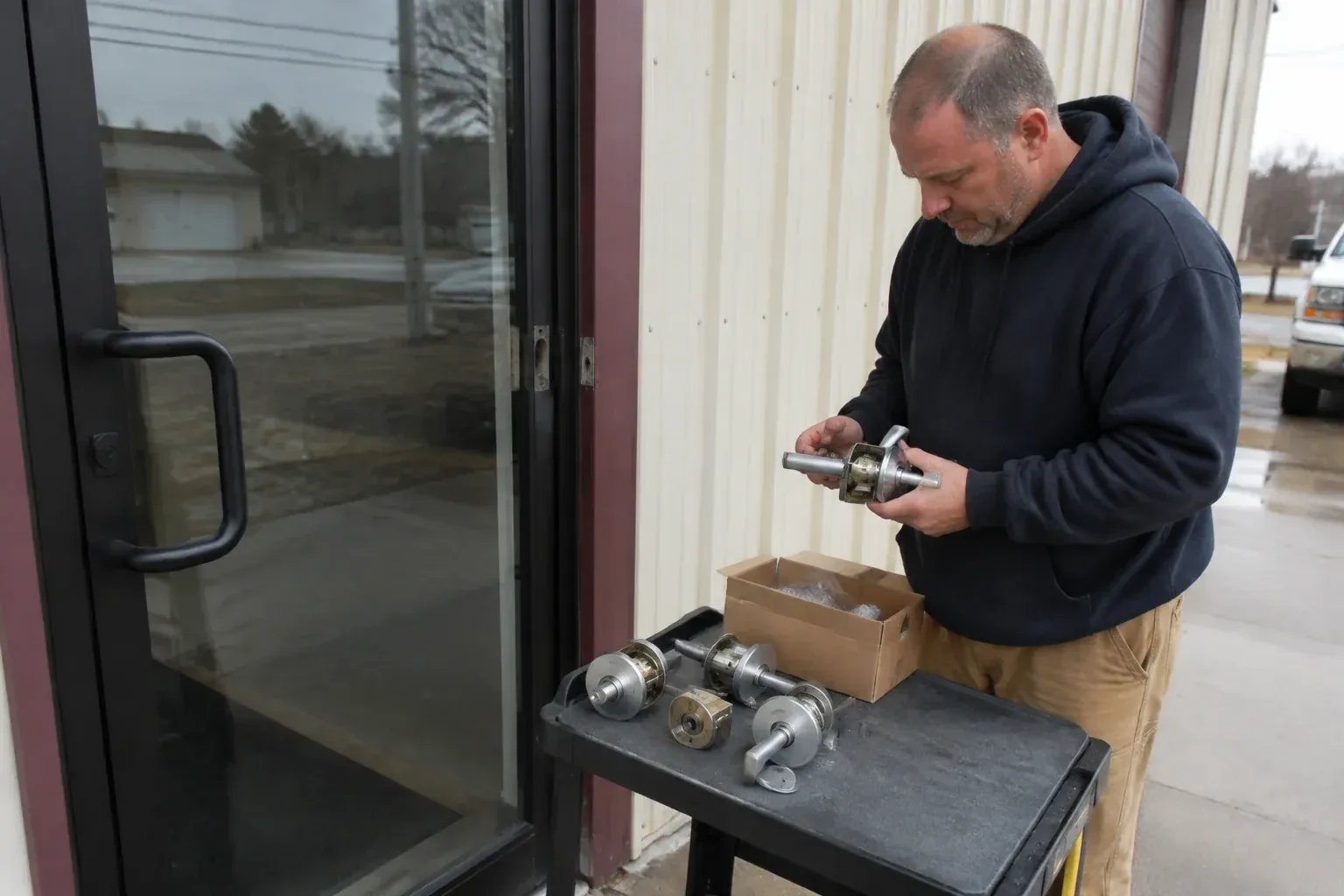
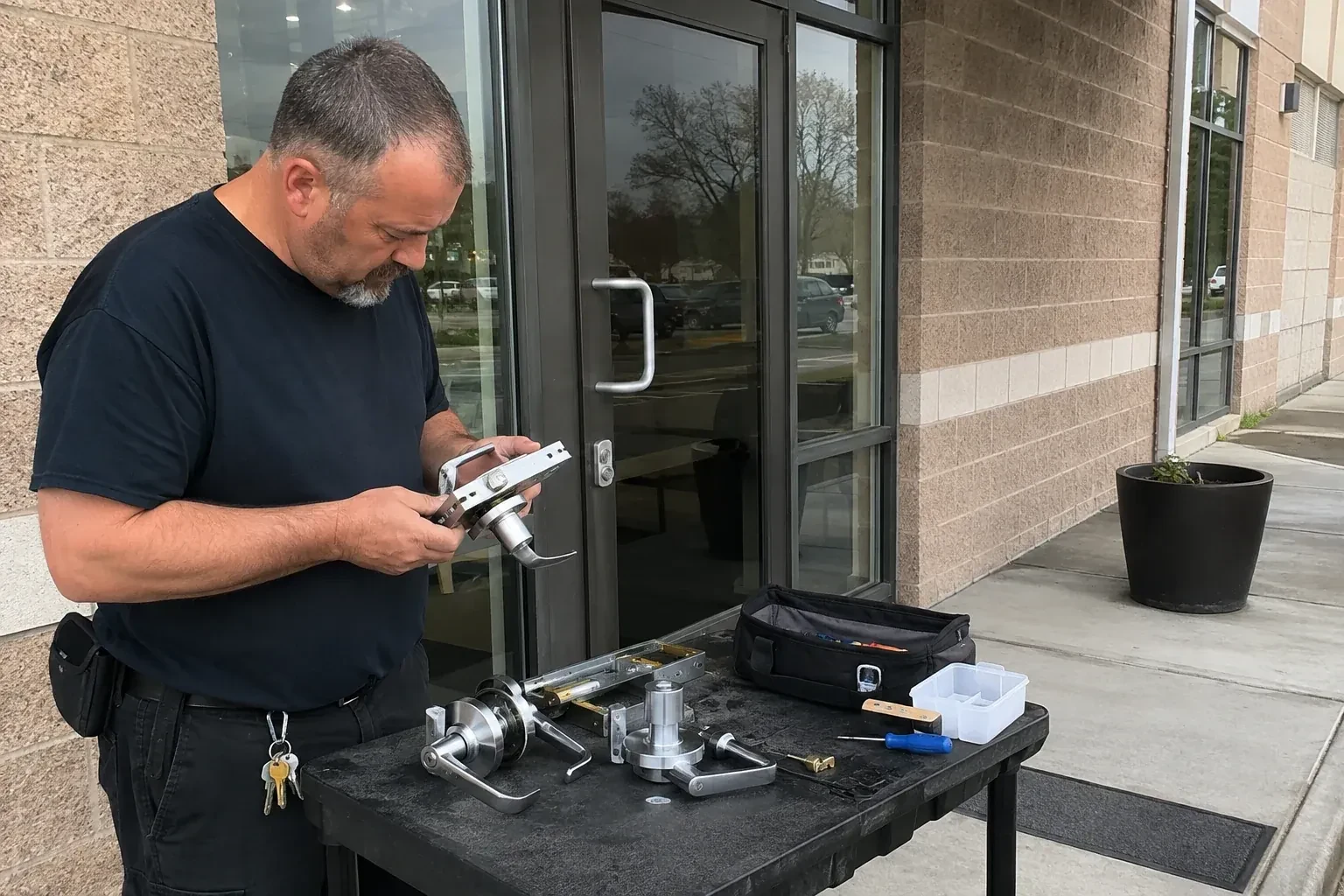
The new hardware is installed into the existing prep, with the lock body or lockset, strike and any reinforcing plate seated so the door closes without binding. On a narrow-stile storefront door, the hookbolt or deadlatch is aligned so it engages the keeper across its full travel rather than catching on one edge. On a mortise-prepped door, the case is fitted so the trim sits flush and the spindle and cylinder line up with the existing holes cut for them.
A storefront that closes the way it should
For a narrow-stile or glass storefront door, the finished job means the hookbolt or deadlatch engages fully across its travel every time, without the shoulder-check that a worn or mismatched lock used to need. Staff closing up for the night can throw the lock once and trust it caught, and the business is no longer relying on a habit of double-checking a door that should simply work. The hardware's finish is also suited to public-facing use, holding its appearance under daily handling.
Commercial-Grade Lock Replacement
In the van
- Heavy-duty cylindrical lockset
- Mortise lock body
- Hookbolt and deadlatch hardware
- Strike plates and keepers
- Restricted keyway cylinder
What affects the quote
Same fees day, night or weekend
1Interchangeable-core hardware
Interchangeable-core cylinders cost more up front than standard ones but reduce the cost of every future rekey, since the business can swap cores itself. Whether that trade-off suits you shapes which cylinder type is quoted.
2Grade and duty rating of the lock
Hardware built for higher cycle counts and rougher daily handling costs more than a lighter-duty equivalent, and the right grade for a busy delivery door is not the same as for a quiet interior office.
3Site access and building type
A ground-floor storefront is the simplest case to reach and work on. A unit inside a larger building with its own access rules, or a site requiring coordination with building management, can add steps the quote takes into account.
Commercial-Grade Lock Replacement: questions
What is the difference between a mortise lock and a cylindrical lockset?
A mortise lock has its whole mechanism, latch, deadbolt and sometimes a separate handle function, built into one case that sits inside a pocket cut into the door's edge. A cylindrical lockset is a bored-in unit, simpler to service, common on standard commercial and residential doors alike. Which one your door takes depends on how it was originally prepped, not on preference alone.
Who should hold the master key once the system is set up?
That is a decision for the business, not the locksmith, but the general practice is to limit master keys to the smallest number of people who genuinely need building-wide access, and to log who holds each one. Sub-master and change keys can then cover departments, shifts or single doors without every key holder carrying access to everything.
My storefront door is aluminum and glass. Does it need special hardware?
Yes. An aluminum storefront door has a narrow stile, the vertical metal frame around the glass, that a standard mortise or cylindrical lock cannot physically fit into. These doors take a narrow-stile lock or a hookbolt built specifically for that slim profile, and matching the hardware to the frame is what lets the bolt engage the keeper fully instead of catching at an angle.
Commercial Locks
- Master Key System DesignOn the warehouse floor, a shift supervisor's key opens the loading dock, the tool crib and the…
- Access Control InstallationYou just leased the empty unit next door and want the new tenant to open their own suite without a…
- Panic & Exit HardwareTwo doors used to swing as a pair at the community hall entrance, but one leaf has started closing…
Commercial-Grade Lock Replacement near you
Whether you own a home in Scotch Block, run a shop or manage a few rental units, the lock services here are organised the way people actually ask for them. Start with the problem you have today, and read on to see what else on the door might deserve a look while a locksmith is already there.